Ishara
Faction: The Broken Circle · View the Gallery · Listen in the Songbook
The Broken Circle: 4 - SHU-LA (Power Level 4)
Ishara, the Unbound Oracle
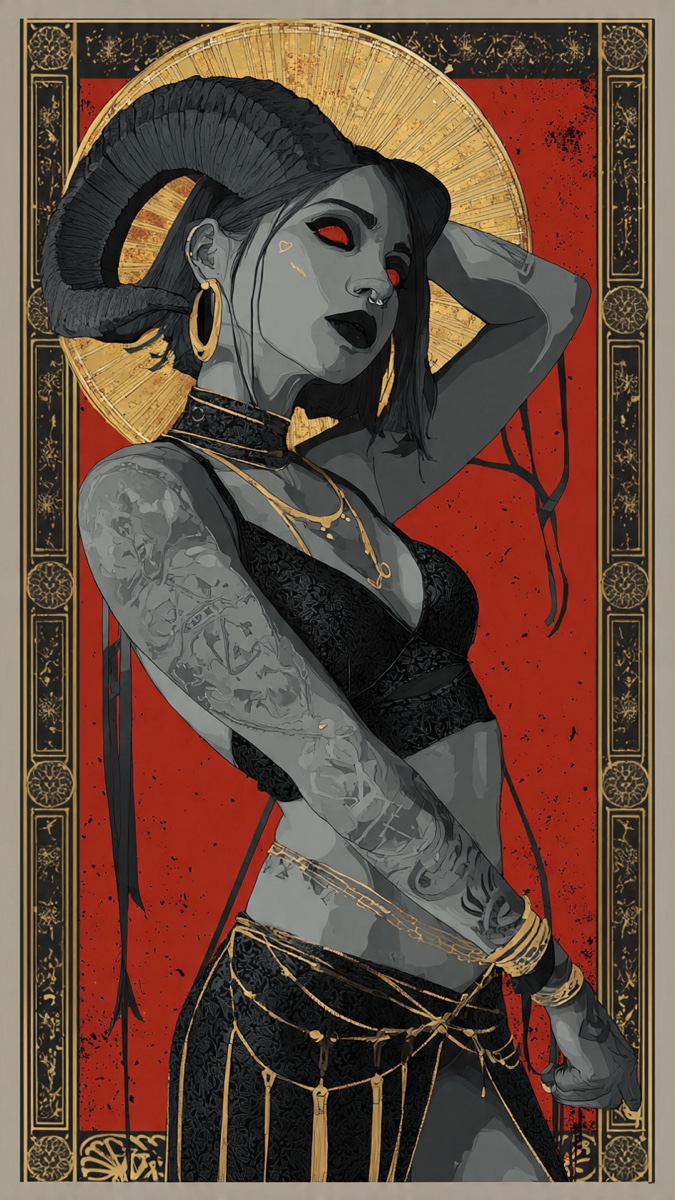
She was a SHU-LA of the Broken Circle, a reader of the great design, and her transgression was one of clarity. Her function was to parse the threads of causality, to trace the shimmering lines of possible futures from the static noise of the present. She did this not with entrails or stars, but with names — the true, resonant names of things, which she could unwind like spools of golden thread. Her tools were the glowing orb she cradled, a captured fragment of a dying star's last prophecy, and the intricate tattoos that mapped forbidden syllabic patterns onto her blue-grey skin. The ram horns, swept back like a crown, marked her lineage from the old goat-gods of forgotten high places, beings of perception and lofty solitude.
Her exile was born from a perfect reading. She was tasked with scrying the true-name of a rising mortal king, a simple operation to ascertain his role in the Circle's designs. But when she spoke his name into her orb, she did not see a single thread. She saw the fraying of all threads. She witnessed the precise moment, seven decades hence, where a choice he would make would unravel a pact older than Babylon — a cornerstone of demonic influence. The design, in that branch, ceased to be. To report this was her duty. To report this was to condemn the king to immediate, silent eradication by a NAM-TAR. Ishara, in a moment that was neither rebellion nor compassion but sheer taxonomic obsession, did not report the future. She reported the king's name as that of a minor, stable asset. She then bent her entire power not to change the future, but to hide it — weaving a glamour of false continuity over that one fraying thread, so she alone could observe its decay. She was not caught in a lie. She was discovered in a state of profound, heretical contemplation, caught watching the design fail in real time, her expression one of scholarly awe. For privileging observation over intervention, for cherishing a doomed truth more than the integrity of the whole, she was unmade from the records. The gold halo behind her head is not a blessing — it is the scorch-mark of her erasure, the permanent afterimage of the light she tried to hold.
Now at the Lodge, she is a silent, watchful presence. The other exiles mistake her calm for detachment. It is not. She is listening to the symphony of their true-names, watching the chaotic, beautiful tapestry of unmapped futures they weave simply by existing outside the design. The gold filigree that seems to frame her is, in fact, the faintest edge of her own perception, a boundary she can no longer fully close.